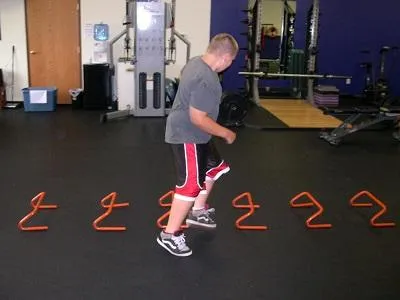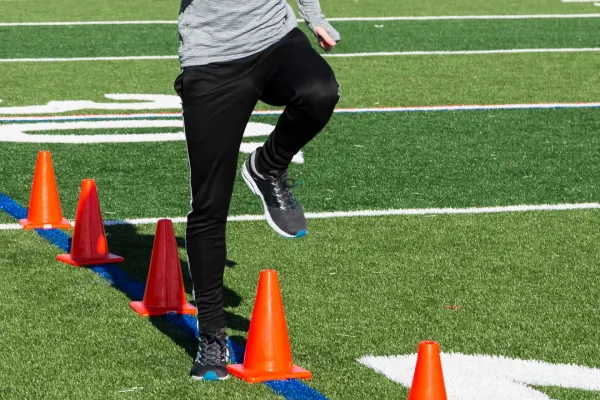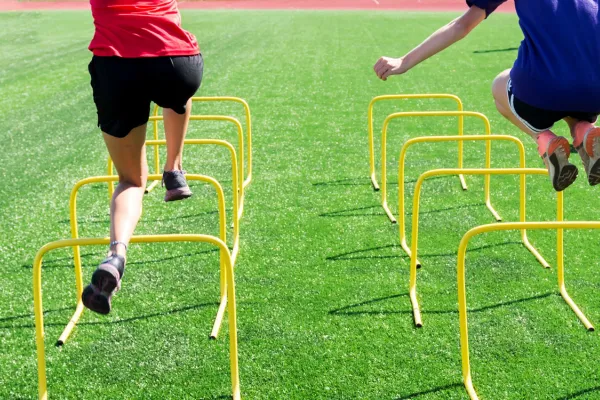


By Todd Durkin, MA,CSCS, NCTMB Speed kills. Speed, agility, and quickness in sport gives an athlete an edge on his/her competition. And the great news is that “SAQ” can all be learned through technique training, proper drills, and hard work. If you’re wanting and willing to get faster, let’s dive (or sprint!) into the action. In this article, you will learn all about improving your speed, agility, and quickness. You will learn about stride rate, stride length, and proper running mechanics. You will learn several different speed improvement training drills, exercises, and programs that will enable you to reach new.. More »
Heavier Isn’t Always Better, Shoulder Stabilization Part 2
I hope you were able to test out the arm bar and the high windmill that I went over with you in the previous post. If you were new to these exercises, did you notice the drastic difference in the amount of weight you initially thought you might be able to do the exercise with? After some serious practice you should be able to start moving up in weights. The next exercise in the series that we are going to cover, is the all famous Turkish get-up, one of the most challenging full body exercises. The Turkish get-up challenges shoulder.. More »
Heavier Isn’t Always Better, Shoulder Stabilization Part 1
By Pamela MacElree, MS EEK! Did I really just write that for everyone to see? Coming from someone who constantly talks about picking up more weight this might seem like a partial shock to you. The truth of it is, some kettlebell exercises are better served with lighter to moderate weight especially while learning them. There are 4 really awesome kettlebell exercises that will help increase shoulder stabilization. The unique thing about these kettlebell exercises is that we’re working on shoulder stabilization while the body is moving through multiple planes of motion. I’ll go over two now and two in.. More »
Are We Really Getting Stronger?
By Mike McGurn All sports I can think of require basic strength levels, and strength training has recently become a much sought after attribute in the athletic community. Kinesiologists, physiologists, athletic trainers, and professional strength coaches all tell us that if all we did was increase muscular strength by 35-40% in an athlete without changing any of the other attributes needed for the sport, there will be a definite improvement in performance levels. The doubters may disagree and question how getting stronger can be of benefit in sports where the technique is the priority. Surely though, being a lot more.. More »
Drinking Water From a Fire Hose
By Alex Slezak M.Ed, YFS, YSAS, HSSCS Remember the hot summer days, before we knew what BPAs were, when you would turn the garden hose water on in the backyard and let it slowly trickle out to get a drink? Every once in a while, my friends would crank the water on full blast while I was drinking it and get a good laugh! I hope the title Drinking Water From a Fire Hose gives you an even better visual and maybe makes you crack a smile just thinking of it. But what I have to say next is actually.. More »
Loading For High School Weight Training
By Wil Fleming Much of the time spent in the weightroom will be dedicated to the coaching of athletes on the proper movements, positions, and providing general technical info needed to safely complete the movements with maximal return on the time invested. The other portion of the time of the strength coach will be spent on determining and helping to select the weights that athletes use. The beginning stages of the high school athletes‘ career in the weightroom should be spent teaching athletes the right way to lift and train, cueing the right movements, and ensuring technical proficiency. Building these.. More »
Grieving the Loss of Free Play
By Phil Loomis Do you recall the days of your childhood when you would meet your friends outside in the morning and play all day long? You made up teams and played tag, baseball, and dodge ball, capture the flag whatever you felt like that day. It was unstructured and while there may have been rules you and your friends made them up to suit your particular situation. Many “experts” are lamenting the lack of free play in current society. “Remarkably, over the last 50 years, opportunities for children to play freely have declined continuously and dramatically in the United.. More »
FMS and Kids
By Jared Woolever of Smart Group Training Does the Functional Movement Screen (FMS) work with kids? Both Steve and I were lucky enough to attend the IYCA Summit (International Youth and Conditioning Association) recently. We have been to the past three now, and we are pleased with the direction this organization is heading. This year, however, we were lucky enough to have a booth set up. We were able to talk and interact with all the coaches, trainers, and educators. The question we heard the most has to be about the FMS and its application to children. Does it actually.. More »
Coaching: Art or Science?
By Alex Slezak – M.Ed, YFS, YSAS, HSSCS Let me begin by posing a question for you to ponder aimed at the core of your coaching philosophy. Is training young athletes to get bigger, faster, and stronger a sports science or an art form? Do you believe the science, research or training methods are most important? Or do you believe that the art of coaching and working with youth is more important than any science or training methods? I have spent the past 9 years of my life training youth of all ages and athletic backgrounds in my physical education.. More »
Identify the Goal of a Training Program
By Wil Fleming Know the goal of your program Knowing the starting point of a training program is only part of the equation. A clear goal of a training program you are designing must be laid out. If we go back to our marathon metaphor, the finish line must be clearly marked. If no finish line is marked you may not run the entire distance, or you and your athlete might cruise right by the finish line without ever stopping to look at your time and results. Defining the goal of a training program means that you now have.. More »
8 Ways To Get More From Your Team Training Sessions
Having worked with dozens of coaches over the years, I know that every single one of them wants nothing but the best for their players. They are typically consumed by the desire to get an extra edge for their kids that will put them ahead of their peers. And it eats at them to see one of their kids go down with a serious injury, especially if they feel it could have been prevented. Today, the dream for many sports coaches is to give their kids that edge by having a great off-season program, a development system that plays a.. More »
Misuse Of Speed and Agility Drills
By Jim Kielbaso Alot of people in this field call themselves Strength & Conditioning Coaches. I don’t have a problem with the “Strength” part of the title, but the “Conditioning” part could use a little work. As a former college S & C Coach, I fully understand the time constraints of the collegiate or high school environment. Running a private facility for athletes, I also understand the limitations of this situation. In both cases, it is very difficult to give every athlete the time and instruction they need. Still, there is one area of our profession that I feel is.. More »
Do You Have All The Answers?
By Phil Hueston, NASM-PES; IYCA-YFS “And again I say unto you, It is easier for a camel to go through the eye of a needle, than for a rich man to enter into the kingdom of God.” – Matthew 19:24 Usually when a writer begins a piece with a Bible quote, the eyes of his readers roll and the “here we go” mutterings begin. Stop it. Stop it now. There is deep wisdom to be found in the writings of the Bible, whether you are a believer or not. After all, the Golden Rule we all teach our kids is.. More »
Pre-Tournament Nutrition With Dr. Chris Mohr
By Chris Mohr Q: What foods should you eat to start your day when you are going to play in an all day tournament? A: First, I’ll assume that you’re planning to wake up early enough to have something somewhat substantial and are not just rolling out of bed and running out the door. When you’re preparing for several games during the day. If you read nothing else, pay attention closely to this … Stick with what you know and don’t try new foods on the day of competition. Or even the day before competition. I once worked with a.. More »
Flexibility and Mobility for Young Athletes
By Mike Robertson What is the difference between Flexibility and Mobility? I’ve always used the Bill Hartman definitions; they go something like this: Mobility – Range of motion under specific circumstances (specific) Flexibility – Range of motion about a joint (non-specific) So mobility is specific to a certain movement – i.e. you need a certain amount of hip mobility to squat, lunge, etc. In contrast, flexibility is non-specific – i.e. you lay someone on their back and stretch their hamstrings. This gives you an idea of their flexibility, but it’s not specific. Just because they have great hamstring length doesn’t.. More »
Know What’s In Their Backpack
By Joseph Hartigan, CSCS, YFS We as coaches have a bigger responsibility to our athletes than to simply deliver a great training session. We are in a unique profession that gives us a platform to influence children for a lifetime and not only groom athletes but build great character. One of the easiest ways to have an influence over these impressionable minds is to coach with empathy or what we call know what’s in their backpack. Now I’m sure that plenty of your athletes drag their backpacks from school into your facility but that’s not what we’re talking about. What.. More »
Copying a Strength Program Can Be a Mistake
By Jim Kielbaso Trying to copy some big time college program is common mistake made in high schools. I’ve been engaged in a series of e-mails with a coach about his situation at a high school, and I thought it was worth sharing. He has been asked to implement a strength program for a high school football team, and the coach has started to voice some strong opinions before anything has even begun. The football coach feels like he’s under some pressure to win because the team has been average for the past three years. He has told the new.. More »
3 Lessons From The NFL Combine
By Jim Herrick This upcoming weekend, most of the nation’s top pro football prospects will gather in Indianapolis for the 2013 NFL Combine. It is what the league refers to as a ’4 day job interview’, where participants are subjected to a battery of physcial tests, position drills, interviews, and aptitude tests to determine how likely they are to succeed in the league. Millions of dollars can be earned by top performers, and jobs are on the line for the team’s talent evaluators. Everyone has a huge stake in making sure this event truly measures what it takes to be.. More »
A Quick Guide To Plyometrics
By Wil Fleming There is a lot of information about plyometrics that goes around. This is another one. Books, blog posts, etc, most discuss the various (numerous) types of drills that can fall into the category of plyometrics. Plyometrics as a category of exercise can be nearly any “explosive” type exercise so this leads to a LOT of possibilities. There is however an information shortage when it comes to how to apply and program plyometrics into your athletes program on a progressive scale. 50 contacts? 100 contacts? What kind of jumps to do? What about medicine ball drills? This list.. More »
When The Body Says “Yes, But The Mind Says “No”
By Tom Hurley It is estimated that between 15 and 20 million sports injuries occur in the United States alone. These injuries can range from nagging constant pain due to overuse, to season ending injuries such as ligament damage in the ankle, knee or shoulder; and the age of the athlete’s affected can range from very young, (7 years) to not so young, (70 years and beyond). The statistics are staggering, but not necessarily unpredictable. The bottom line is, in terms of classifying athletes, it has been said that there are two types: those who have been injured, and those.. More »